Brand DNA 101: Brand Positioning Statement Template (+ Real Examples)
 Ling Zhang
A brand positioning statement is a short way to explain who you’re for, what you help with. If your message keeps changing, or people don’t really understand what makes you different, it’s usually a positioning issue. This article gives you a simple brand positioning statement template, along with real examples, so you can put your thoughts into words and understand your brand before starting any branding design.
What a Brand Positioning Statement Really Does
A brand positioning statement guides how your brand shows up and what it focuses on. It’s not a slogan and it’s not customer-facing—it’s an internal tool that keeps your messaging clear and mains brand consistency.
Once your stance takes shape, drafting site text, ads, or deals shifts - sharper, less scattered. Instead of aiming at every face in the crowd, you tune in to those who matter. A strong positioning statement fixes this by clearly defining who you serve, the problem you solve, and why you’re the better choice. Once that foundation is clear, brand guidelines translate the strategy into consistent visuals and messaging across every channel. Think of it while deciding anything - if what you do lines up with that, then keep going that way.
Different Types of Positioning statement templates
One size never fits all when setting up a business stance. Depending on who buys and what matters to them, different tools shape the fit. Awareness levels steer choices more than anything else does.
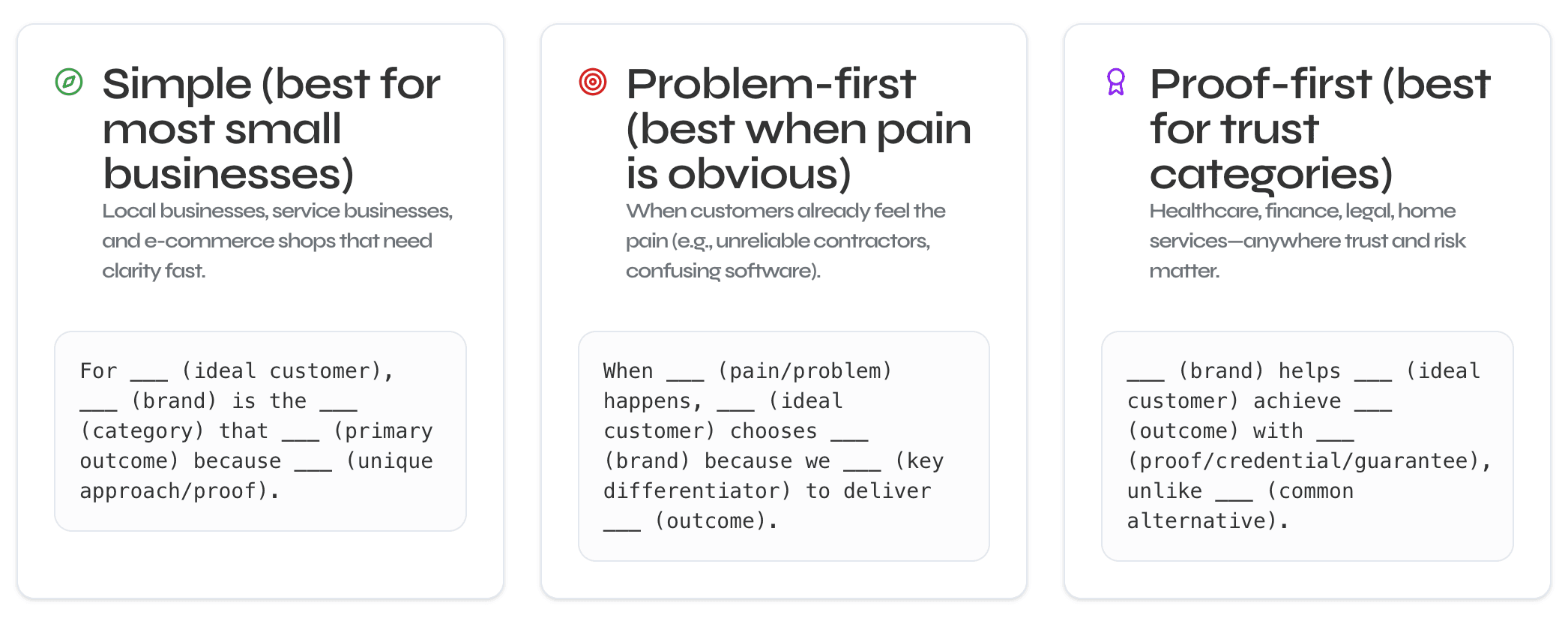
1. Simple positioning (best for small businesses)
Use this when:
You want to clearly explain what you do and who it’s for
Template:
“ For ___ (ideal customer), ___ (brand) is the ___ (category) that ___ (outcome) because ___ (difference). ”
2. Problem-first positioning (best when pain is obvious)
Use this when:
Customers actively complain about the same issue
The problem is clear and urgent
Template:
“ When ___ (problem) happens, ___ (ideal customer) chooses ___ (brand) because we ___ (how) to deliver ___ (outcome). ”
3. Proof-first positioning (best for trust-heavy industries)
Use this when:
Customers feel risk or uncertainty
Proof strongly affects buying decisions
Template:
“ ___ (brand) helps ___ (ideal customer) achieve ___ (outcome) with ___ (proof), unlike ___ (alternative).”
8 Positioning Statement Examples
Not sure how to write a brand positioning statement? Start by reading successful positioning statement examples from other companies to get ideas for writing your own.
1. Nike
Brand Statement:
| “At Nike, we’re committed to creating a better, more sustainable future for our people, planet, and communities through the power of sport.” |
Nike’s positioning statement is about more than sportswear. Built around care for the planet and fresh ideas, it also values opening doors - helping anyone step forward as an athlete, wherever they come from.
2. Apple
Brand Statement:
| “Apple revolutionized personal technology with the introduction of the Macintosh in 1984. Today, Apple leads the world in innovation with iPhone, iPad, Mac, Apple Watch, and Apple TV. Apple’s five software platforms — iOS, iPadOS, macOS, watchOS, and tvOS — provide seamless experiences across all Apple devices and empower people with breakthrough services including the App Store, Apple Music, Apple Pay, and iCloud. Apple’s more than 100,000 employees are dedicated to making the best products on earth, and to leaving the world better than we found it.” |
You’ll often find a brand’s positioning statement at the end of a press release. Apple uses this space to earn trust, while outlining how ideas link across every gadget and system it makes.
3. Google
Brand Statement:
| “To organize the world’s information and make it universally accessible and useful.” |
Google sticks closely to its original mission. it’s how hard they still lean into sorting out facts and turning them into real help. That mindset didn’t lead by accident to a spot near the top of the world’s most prized companies; it built itself there through years of staying focused on making things clearer and easier to use.
4. Facebook
Brand Statement:
| To give people the power to build community and bring the world closer together. |
Facebook positioning centers on connection. Instead of noise, you get updates that show nearby activity while posting helps place personal moments into context.
5. Slack
Brand Statement:
| “Slack is the collaboration hub that brings the right people, information, and tools together to get work done. From Fortune 100 companies to corner markets, millions of people around the world use Slack to connect their teams, unify their systems, and drive their business forward.” |
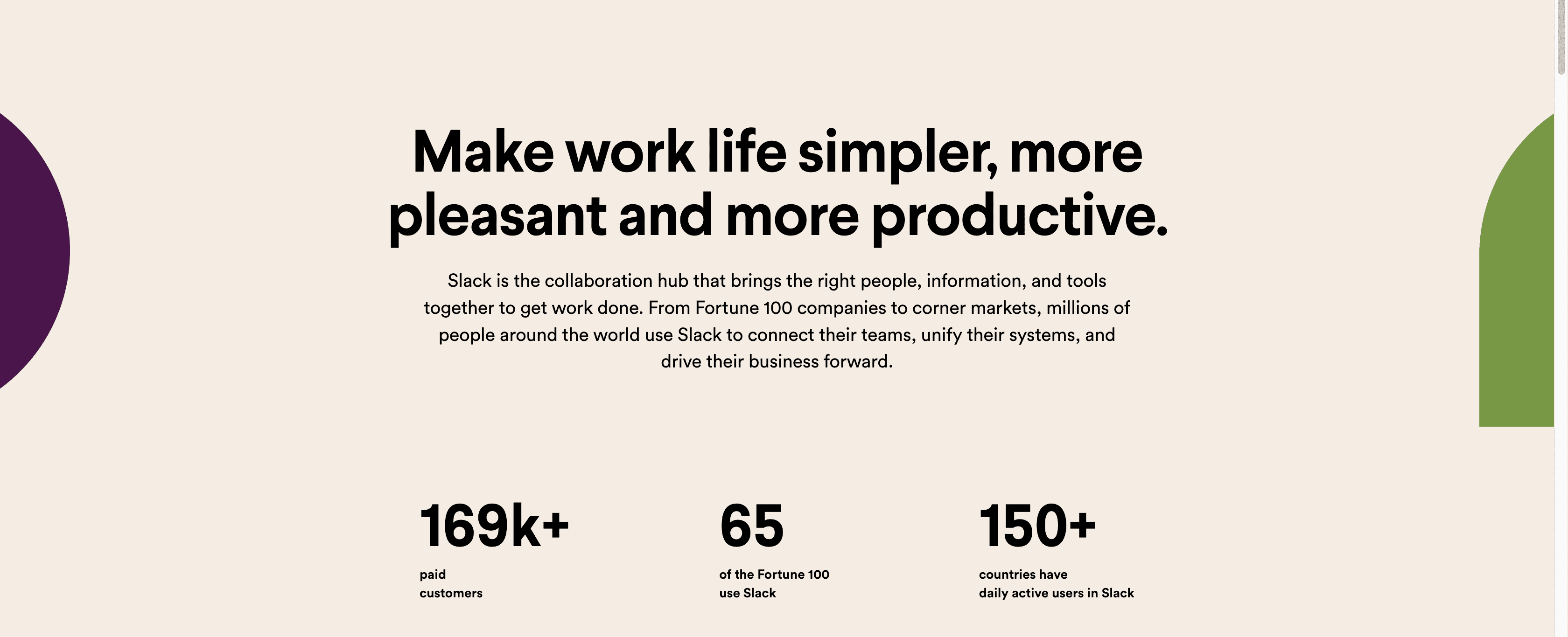
Slack shows how broad its audience can be without losing focus. Whether it’s a large corporation or a small local shop, the core benefit is the same— making team talk easier, less friction.
6. Microsoft
Brand Statement:
| “To empower every person and organization on the planet to achieve more.” |
Microsoft positioning reflects long-term ambition. Helping others grow and thrive became its steady purpose, shaped by constant effort in tech.
7. Tesla
Brand Statement:
| “To accelerate the world’s transition to sustainable energy.” |
Tesla’s positioning is built around a clear belief. Electric doesn’t equal lacking; instead, it promises power without sacrifice. Performance stays sharp, craftsmanship holds true, style remains unchanged.
8. Alexa
Brand Statement:
| “Alexa is a trusted source of insights into digital behavior that marketers use to help win their audience and accelerate growth. Subscribers to the Alexa Marketing Stack leverage rich competitor and audience insights that help them better understand their audience, discover opportunities for growth across multiple marketing channels, and manage the day-to-day workflows of planning, creating, optimizing, promoting, and measuring the effectiveness of their content marketing.” |
Alexa’s positioning is very specific. It shows exactly whom the product aims at, which hurdles it removes, along with reasons behind the value of its insights. When it comes to intricate, information-intensive tools, clarity at this scale tends to ease user confidence.
Start Crafting Your Brand DNA
Once your positioning is clear, the next step is making it usable. That’s where Brand DNA comes in.
With uBrand, you don’t have to fill out long questionnaires or start from zero. Just enter your website URL or a social media link, and the AI works with what you already have.
uBrand looks at your existing brand and turns it into a complete Brand DNA. You’ll get a clear logo foundation, a simple one-sentence brand intro, the fonts and colors you’re already using, plus your mission, vision, values, slogan, and brand voice.
Instead of guessing or rebuilding everything, you get a practical brand style guide you can use right away for design, content, and marketing—clear, consistent, and aligned with your positioning.